Works
Press Release
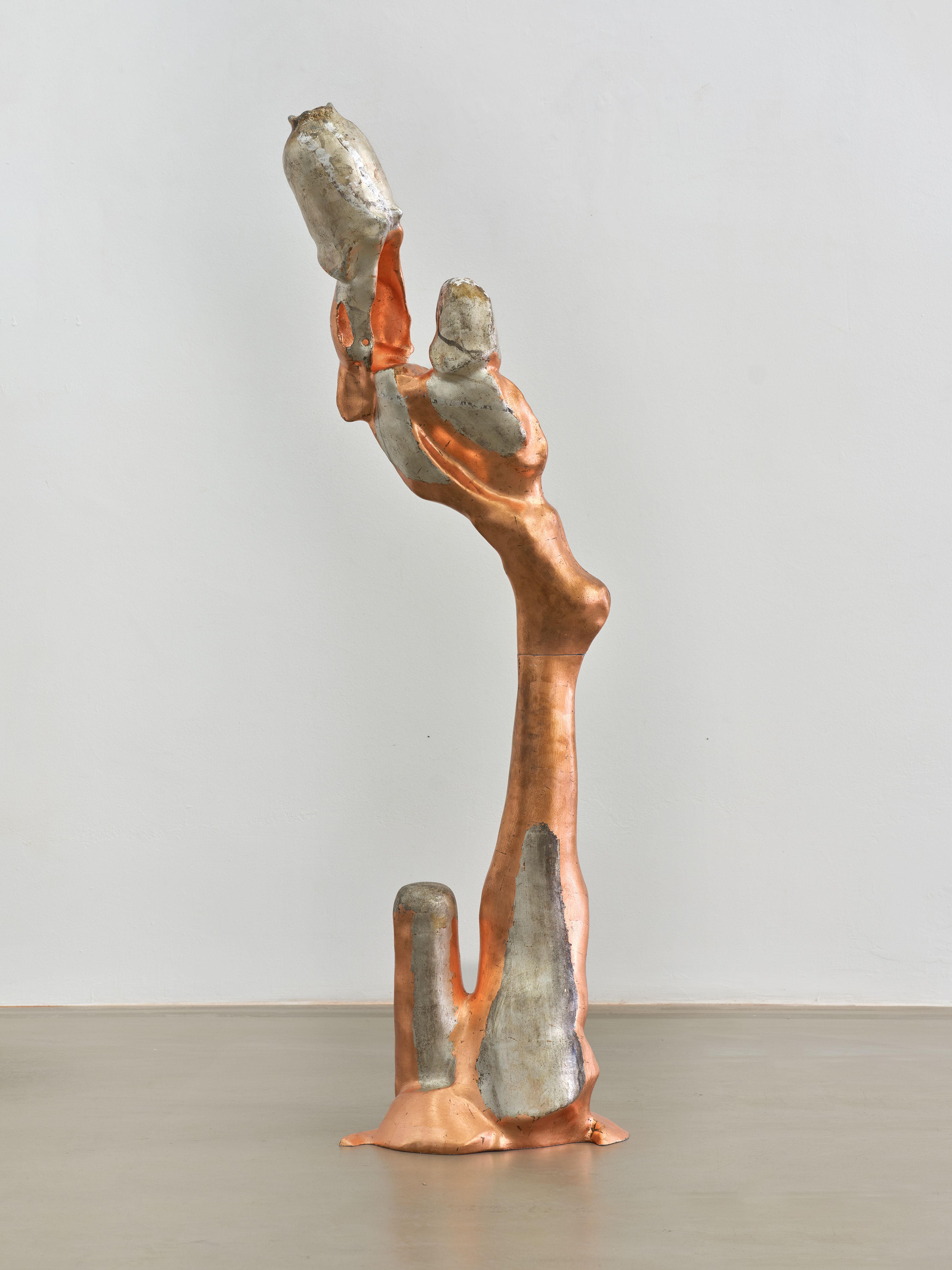
Berenice Olmedo’s new sculptures take shape as bodies that seem to press outward. They do not present themselves as finished objects. Instead, they appear to emerge into space, as if they were extensions of something larger that remains partly out of view. Where earlier works at times evoked celestial forms, these sculptures feel closer to geological ones. They recall formations that grow, shift, and surface over time, like extremities breaking through a surrounding mass. This sense of emergence can be understood as a process of emanation. The works do not begin as autonomous forms. They originate in prosthetic and orthotic sockets, objects designed to support, stabilize, and extend the human body. Olmedo scans and reproduces these elements, then repositions them. What once served a precise, technical function becomes a new kind of presence. The sculptures carry the memory of their origin, but they no longer belong to it. They extend outward from systems of care and correction into a different register, where function gives way to form, and use gives way to autonomy. Emanation here is not abstract. It describes how something persists across different states. Each sculpture holds several layers at once: a technical device, a trace of a body, and a distinct form that stands on its own. Olmedo’s practice suggests that an individual is never singular or self-contained, but composed through overlapping structures, supports, and projections. The sculptures take on a certain presence as if they were beings, each with its own posture and character, while still remaining tied to a shared system of origin. They stand as individuals, but also as parts of an ongoing continuity. As a result, the works do not represent the body. They test its limits. They focus on points of contact, pressure, and exposure, where the body meets what supports or replaces it. Boundaries are renegotiated. Each form reads as a fragment, but carries the weight of a larger whole, as if it had been cut from an active process rather than shaped in isolation. Their surfaces reinforce this condition. The sculptures are covered in copper and silver sheets, then oxidized through time and chemical treatment. The result is a skin that feels reactive and alive, marked by shifts in color and texture. These are not neutral finishes. They register transformation. The surface becomes a record of change, where material continues to evolve even after the form is set. Naming plays a role in this shift. By giving each sculpture a distinct identity, Olmedo brings them closer to the status of individuals. At the same time, they never fully detach from one another. They remain connected through their shared origin and material logic. Together, they form a field of related presences, each separate, but none entirely alone.